Richard Billingham
An artist I have been inspired and heavily influenced by Is Richard Billingham.
Born 25 September 1970, Richard Billingham is an English photographer and artist, film maker and art teacher. His work has mostly concerned his family, the place he grew up in the West Midlands, but also landscapes elsewhere.
Billingham has published the monographs Ray's a Laugh (1996), Black Country (2003), Zoo(2007), and Landscapes, 2001-2003 (2008). He made the full length video film Fishtank (1998) as well as various shorts, and wrote and directed Ray (2016), part 1 of a 3-part feature film. He is best known for Ray's A Laugh which documents the life of his alcoholic father Ray, and obese, heavily tattooed mother, Liz.
He won the 1997 Citibank Private Bank Photography Prize (now Deutsche Börse Photography Prize) and was shortlisted for the 2001 Turner Prize. His work is held in the permanent collections of Tate, the Victoria and Albert Museum, and Government Art Collection in London. Billingham is based in Swansea and teaches art at Gloucester and Middlesex universities.
Billingham shot his photos with a film camera for the "Ray's a laugh" series as he had no other choice, but told me himself that he still prefers to use film rather than digital. I decided to email Richard Billingham to ask him some question about photography and the "Ray's a laugh" series. Here is my email and his response:


This image was shot in 1994 with a film camera, which we can guess from the pinkish tint in the image. This shot depicts Billinghams mother, Liz, laying on the sofa and watching TV. She appears very comfortable in this setting. It is clear that this image is a product of its time with the 90's style of sofa, wallpaper and clothing. Liz seems unfazed by this image being taken, and is obviously used to it, giving it the essence of a true documentary photo. Without knowing contextual information, we can guess that this is depicting a working class family. We can assume this by the setting, one of the pillows are ripped and broken, Liz appears unkempt and her clothing is unfashionable suggesting that money is tight and these things are not a priority. This image also suggests that Liz is somewhat of an independent woman as she can enjoy her own company, perhaps she is busy, often taking care of her alcoholic husband Ray and rarely gets a moment to herself. So it is nice for her to relax on the sofa for a moment.

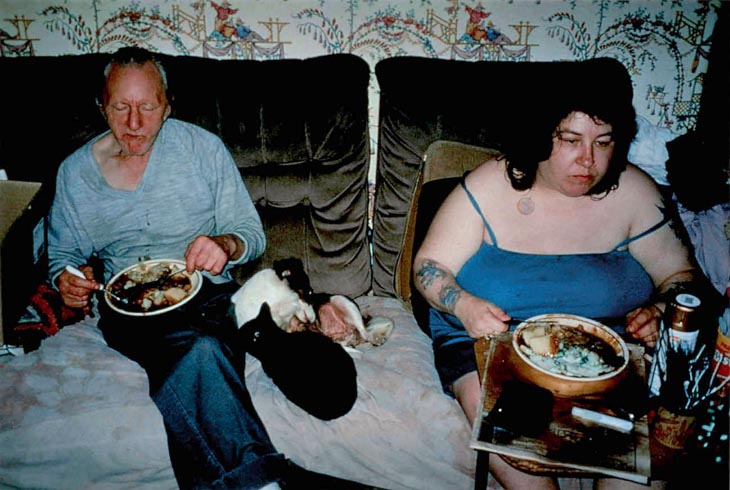
This image was shot in 1995 and shows Ray and Liz eating their dinner together on the sofa. This image was also clearly shot on a film camera leaving a green tint on the image. Billingham is really relying on the decisive moment for his documentary shots, capturing the life of a working class family, in poverty England, perfectly. This image actually says quite a lot about the family. The fact that they are eating their dinner on the sofa suggests that they are quite informal and not really bothered by mess or dirt. Additionally, they are eating with animals beside them which emphasises this idea. Ray is blinking in this image whilst Liz is looking straight faced and probably watching the TV while eating her dinner. She does seem quite tired and from this we can assume that she has been taking care of Ray and most likely cooked the dinner for the family. The married couple are sitting quite a distance apart and this could suggest emotional distance as well, but we cannot know this for sure just from one image.

This image was shot in 1996 and depicts a frail looking Ray, happily receiving some boiled eggs from Liz. This image appears quite a bit brighter than the previous two images, this could be something to do with progression in photography, or perhaps has just been edited with some white balance. I like the composition in this image, with ray on the sofa in the bottom right and Liz towering over him, being framed by some ornaments on the wall behind her. The fact that Liz is towering over Ray suggests that she is the matriarch of the family, and a strong figure in the household. She is clearly the main care giver, taking care of Ray who appears to getting old and fragile as the alcohol gets the best of him. She seems calm and content in this role, and Ray is very happy being taken care of. The house still seems messy with a broken cardboard box on the sofa beside Ray. Also, I can assume that there is lots of dog hair in the house from the two dogs sitting on the sofa.

This fourth image was shot in 1995, and depicts Billinghams younger brother sitting on a garden chair, holding a baby girl. This image particularly emphasises the family's money situation as it is unusual to sit on a garden chair in the living room. Although this appears normal for Billingham's brother. Although the baby is crying, the young man seems comfortable holding her, supporting her head as she is sitting up. From the research that I have done, Billingham mentions his younger brother being lazy, and quitting every job he gets after two weeks, although it is a strong stereotype for working class people to be lazy so this wouldn't be unusual for most viewers. The composition in this image is quite nice, as the two are framed nicely within the green wall behind them, filling the empty space there is also a nice depth of field ensuring that Billinghams brother and the baby are the main focus of the image.
Influence:

Above is one of my best images from my shoot 1, and although the main photographer influence for this shoot was Nick Waplington, I had also been looking at a lot of Richard Billinghams work and particularly the way that his images come out with slight tinted colours due to shooting with film, I wanted to create this same style despite shooting in digital. These two images are similar in composition and subject, depicting two family members sitting beside each other indulged in something in front of them, in Billinghams photography this is usually Liz or Ray watching the television, in my shot they are focused on the conversation. By coincidence they even have their legs crossed like Ray in the image above. Both of these images purposely don't present the peoples lives as glamorous and show people as they truly are in the moment just living their everyday lives.

VERY GOOD HERE JUSTINE YOU HAVE A PRIMARY RESEARCH SOURCE (Richard Billingham) and you have gone in to some depth of analysis on Richard Billingham.
ReplyDelete